|
The Society of Folk Dance Historians (SFDH)
Do You Want That Dance?
[
Home |
About |
Encyclopedia |
Periodicals | CLICK AN IMAGE TO ENLARGE |
|
Do you want that dance? What will you do to own it?
A) Change its name? Change its footwork? Change its rhythm? Change its music? Change its song? Invent a history and cite obscure authorities?
Or:
B) Will you acknowledge that other peoples also have worthwhile cultures?
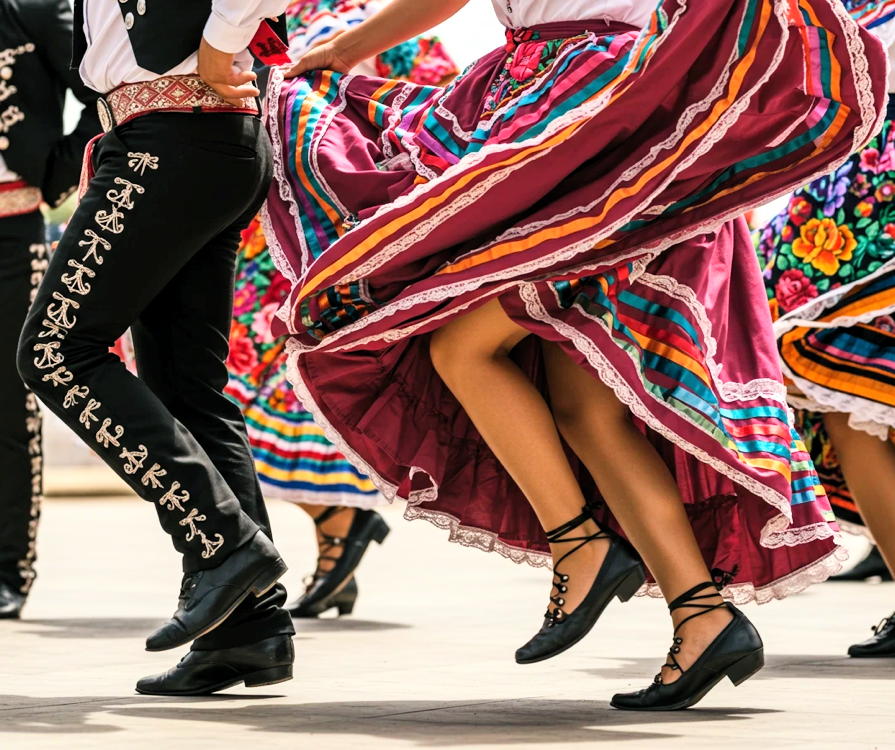
If you are reading this, you probably are a recreational international folk dancer, one of that rare and vanishing breed that developed a fascination with the dances, music, costumes, cuisine, customs, and even languages of other cultures. I did, and that fascination led to the awareness that folk dancing is a mirror as much as it is a window.
So:
You want to own that dance? Welcome to the human race. Sigh.
You want to honor a people by performing their dance as they danced it? Welcome to recreational international folk dancing.
Why It Matters
Who are you? Where do you live? What do you own? Can you prove it? Your documents establish your place in the world and in history. Your state's archives substantiate your documents. But what happens when archives are lost and someone challenges your claims?
Famous dance teacher and world traveler Rickey Holden calls one particularly turbulent region of the earth the A-B-C region: Anatolia, Balkans, and Caucasus. Borders in this area change almost as quickly as the weather, and with as little regard for the people who live there. Changing a border is simple.
a) Kill the people.
b) Destroy their archives, libraries, monuments, and museums.
c) Appropriate their customs as your own.
d) Tell your children: "It's always been ours."
Individually, we cannot stop (a) and (b), but we do not have to accept (c). A distressing number of our dances come from appropriation. Distressing not because the number is large (it is not), but because ANY appropriated dance represents historical revisionism, which leads from one genocide to the next. Worse, historical revisionism not only hides the destruction of a people, it destroys also their very memory, killing them twice. THAT is distressing.
We DANCE for fun. Fine. But we FOLK dance because we care about different cultures. Otherwise, we'd just do aerobics to foreign music. When you change a folk dance, you are appropriating someone else's culture. When you dance a changed dance, you are erasing part of a people's memory.
"But it's such a small part of their memory." Oh? And who are you to say what is important to a culture? The history of the A-B-C region reflects in its dances, and we call that reflection "choreogeography." The Society of Folk Dance Historians (SFDH) has published several articles about choreogeography.
"We do it differently in our village." Really? Or did you just forget the dance? The SFDH has published the histories of over 600 dances and has descriptions of tens of thousands more.
"We learned it from Glavni Kolodvor, and he's a native." And that makes him a historian? Remember point (d) above. Glavni knows only what he was taught. Nothing will change his mind.
"There are many right ways to do this dance." True, and there are wrong ways, ways that defy the cultural context of the dance, the clothing, footwear, terrain, societal constraints, and so on. Do you know the context better than the teacher or author of the dance description? Are you willing to erase part of the memory of a culture just to avoid reading a dance description? To avoid erasing part of the memory of a culture, we should follow the best source for a dance, relative to our use for the dance. In other words, recreational dancing need go no further than the person who taught the dance, but exhibiting before a native audience requires a higher standard of scholarship. This concept of seeking the best authority applies not only to ignorant changing of a dance, but also to malign changing of a dance when country A takes country B's dance and deliberately tries to erase the cultural context by "doing it wrong," which becomes "doing it right" in the new context.
"Everybody in that region shares that dance." Fine. Then make sure you say so.
The forces that change borders will never die. "How much is enough?" John D. Rockefeller answered "Just a little bit more." As I said, we cannot do much about (a), (b), and (d), but we do not have to accept (c), the appropriation and erasure of a culture.
This page © 2026 by Ron Houston.
Please do not copy any part of this page without including this copyright notice.
Please do not copy small portions out of context.
Please do not copy large portions without permission from Ron Houston.